
Failure To Yield Ontario
OTD Ticket Defenders Legal Services has successfully assisted numerous clients in contesting tickets and pursuing appeals for a wide range of traffic violations, including but not limited to “failure to yield” charges.
Whether you’re facing traffic tickets related to not yielding the right of way, failure to stop at a stop sign, or any other traffic infraction, our experienced team is here to uphold your rights and ensure equitable treatment under the law and avoid severe penalties and consequences like insurance implications, demerit points, traffic ticket convictions and other negative possible outcomes.
What Does Failure to Yield to the Right of Way in Ontario Mean?
Failure to yield infractions are covered by sections 136 (1)(b) and 139 (1) of the Highway Traffic Act of Ontario. In each section, the Highway Traffic Act states that drivers must yield to oncoming traffic, when entering from a private road or after a stop sign, in order to prevent creating an immediate hazard for other drivers.
Highway Traffic Act Section 136 (1)(b) Definition
(1) Every driver or street car operator approaching a stop sign at an intersection,
(b) shall yield the right of way to traffic in the intersection or approaching the intersection on another highway so closely that to proceed would constitute an immediate hazard and, having so yielded the right of way, may proceed. R.S.O. 1990, c. H.8, s. 136 (1).
Highway Traffic Act Section 139 (1) Definition
(1) Every driver or street car operator entering a highway from a private road or driveway shall yield the right of way to all traffic approaching on the highway so closely that to enter would constitute an immediate hazard. R.S.O. 1990, c. H.8, s. 139 (1).
It is important to note that simply signaling does not automatically give you the right of way. Even in the event of an unintentional accident occurring or if police officers at the scene determines that the way you entered the flow of traffic infringed on the right of way of others and created a hazard, you could face a failure to yield ticket.
In situations approaching traffic where cyclists or pedestrians are present, a failure to yield infraction could also lead to careless driving charges, which carries more serious penalties.
Understanding “Failure to Yield” Charges
Fail to Yield on Major Roads (s. 136.1(b))
- Mandatory Stop: Drivers must come to a full stop at intersections controlled by stop signs on through highways.
- Yield to Oncoming Traffic: Before proceeding, ensure the way is clear of oncoming traffic to avoid creating hazards.
Fail to Yield at Signs (s.138.1)
- Observe and Assess: Drivers must carefully assess traffic conditions before proceeding past yield signs.
- Prioritize Pedestrians: Special attention should be given to pedestrian crossings to avoid endangering those on foot.
- Road Signs: Understanding and obeying a yield sign is key to safe driving and avoiding tickets.
Fail to Yield on Private Roads (s.139.1)
- Right-of-Way: Drivers exiting private roads or driveways must give way to traffic and pedestrians on the main road and pass safely.
Failure To Yield Penalties
A failure-to-yield ticket carries the following penalties:
- Three demerit points on your license
- $85.00 fine
- An automatic victim fine surcharge
- A conviction on your driving record
Beyond the immediate financial impact, these penalties can have longer-term effects, potentially affecting your insurance rates and overall driving record.
Insurance Rate Effects of a Ticket
When a failure-to-yield incident leads to an accident, it has a two-fold impact on your standing with your insurance company. Your conviction counts as two strikes: one for the accident and another for the traffic violation. This can result in your insurance rates going up for at least three years. If you have other violations on your record or are driving with a novice driver’s license, there’s potential for further rate hikes. In many scenarios, be prepared for an increase of 25% to 50% in your premiums, leading to a notable rise in your insurance expenses.
If you’ve received a failure-to-yield ticket, our team is here to assist you every step of the way. We understand the potential consequences, such as demerit points, fines, and insurance rate increases. Let us handle the legal complexities on your behalf, protect your rights and make sure you receive fair treatment under the law.
How OTD Legal Can Help Fight Failure To Yield Charges
Our expertise is at your disposal. We understand the gravity of demerit points, fines, and the looming threat of increased insurance costs. We ensure your rights are protected and you’re given fair treatment.
Failure To Yield Ticket FAQs
What exactly constitutes a “failure to yield” violation in Ontario?
In Ontario, failure to yield refers to not giving the right of way to oncoming traffic or pedestrians when required by law, such as when merging from a private road or at a stop sign.
What are the immediate legal penalties for a failure to yield ticket?
The penalties include a $85.00 fine, three demerit points on your license, a victim fine surcharge, and a mark of conviction on your driving record.
What should I do if I receive a failure to yield ticket?
Contact OTD Legal for a free consultation. We’ll review your case, advise on the best course of action, and represent you in contesting the ticket.
FREE CONSULTATION & QUOTE
Do You Need To Defend Yourself Against A Failure To Yield Ticket?
We have the skill and experience to help drivers just like you, all while protecting your best interests in the process. We provide free, no obligation, confidential consultations. We help drivers throughout Ontario, including in Kitchener, Georgetown, London, and Windsor, or from our home office in Cambridge. To start a free consultation, text a copy of your ticket to 226-240-2480 or email a copy to help@otdlegal.ca. Once we receive a copy of your ticket, we will call you. As always, we can also be contacted toll-free by calling 1-844-647-6869.
RESOURCES
Our Recent Videos

Do You Need A Lawyer For A Careless Driving Charge
When you find yourself facing a careless driving charge in Ontario, making an informed decision about your legal representation is extremely critical. A careless driving offence under Section 130 of the Ontario Highway Traffic Act can result in significant fines,...
Paralegal VS Lawyer: Who Should Be Fighting Your Ticket?
When confronted with a traffic ticket, you may be wondering if it’s better to hire a paralegal or a lawyer for your defence. Both are licensed legal professionals, but they possess differing levels of education, experience, cost of representation, and areas of...
TRAFFIC TICKET MYTHS
When receiving a traffic ticket, there are many myths that can influence your understanding of the situation. It's important to understand fact from fiction for a clearer legal perspective. Officer Uniform Starting with the classic myth - the officer's uniform,...
RESOURCES
Our Recent Blogs

3 Things to Know Before Hiring a Paralegal
Having a legal issue is never a fun experience. Being charged by the police can be a frightening, costly, and damaging experience with long-lasting consequences if not handled correctly. For that reason, many choose to hire a legal representative to fight their charge...
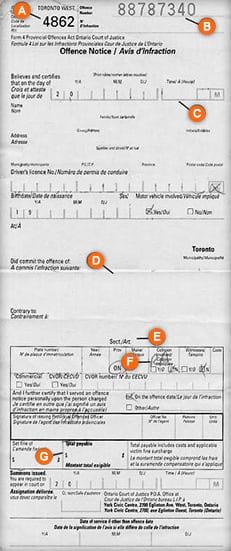
About Your Ticket
A Icon #. Identifies the Ontario Court B Offence #. Your Ticket Number can be tracked at any Ontario Provincial Court C Offence Date D Your Offence E Section Number F If Involved in a Collision G Fine Amount Payable...
Speeding Ticket Overview
Speeding tickets are the most common offences. We can help with speeding charges issued in Ontario, Quebec, and many locations in the United States. If you have received a speeding ticket, it is important to know your legal rights and options as well as the...